

The numbers that matter.
In most of Delta's residential zones, a fence up to 1.2 metres (about 4 feet) can go anywhere on the lot, and a fence up to 1.8 metres (about 6 feet) can go anywhere behind the minimum front setback for your zone. At a street corner, anything inside the 8-metre visibility triangle is capped at 1 metre. Height is measured from finished grade every 2 metres along the fence, and fences on retaining walls follow a separate measuring rule, covered below.
Verified September 29, 2026 against Delta Zoning Bylaw No. 7600
| Anywhere on the lot — 1.2 m | Any residential zone except RD2 (s. 7.5.1(a)). This is the ceiling in front of the front setback line, including along the street. |
|---|---|
| Behind the front setback — 1.8 m | To the rear of the minimum front setback required for a house in your zone (s. 7.5.1(b)). The setback distance varies by zone, so look up your zone before planning. |
| Next to a non-residential zone — 2.4 m | Only along the lot line that borders a non-residential zone, and only behind the front setback (s. 7.5.1(e)). |
| RD2 zone — 0.9 m front | On lots zoned RD2 (Duplex/Single Detached Residential 2), the front setback area is limited to 0.9 m; behind it, 1.8 m (s. 7.5.2). |
| Pool enclosure — 1.5 m | A fence enclosing a swimming pool can be 1.5 m even where the 1.2 m or 0.9 m limit would otherwise apply, and on RD2 lots, or in the front yard of a waterfront lot, it must not block the view of the pool (s. 7.5.1(d), 7.5.2(c)). |
| Arbor — 2.4 m | An arbor (a structure with a substantially open roof) can be 2.4 m anywhere on the lot; in RD2, only behind the front setback (s. 7.5.1(c), 7.5.2(d)). |
| Corner triangle — 1 m | At an intersection, inside the triangle formed by the two lot lines and a line joining points 8 m from the corner, nothing other than a permitted house may exceed 1 m (s. 7.2.1). Does not apply to lanes. |
| Barbed wire — not allowed | Not permitted on any residential lot, or on a lot line bordering a residential zone (s. 7.5.3). |
Planning a new line, or replacing a tired one?
We work across Ladner, Tsawwassen and North Delta, and we check setbacks, corner triangles and retaining-wall heights during the quote, before a single post goes in. One site visit, one fixed written quote, old materials hauled away.
Every 2 metres, from finished grade.
Delta measures a fence from the finished grade at its base, checked every 2 metres along its length (s. 7.5.7). On a sloped yard, a long straight top rail can be legal at the high end and over the limit at the low end, so fences on a slope are usually stepped panel by panel. Delta's bylaw gives lattice or trellis toppers no separate allowance, so we plan the full height, lattice included, to the limit. The one taller structure it names is the 2.4 m arbor.
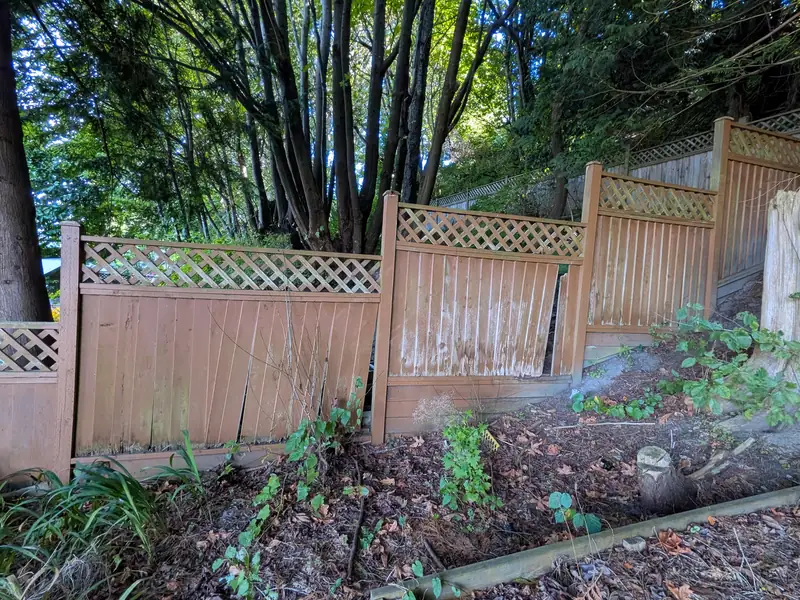
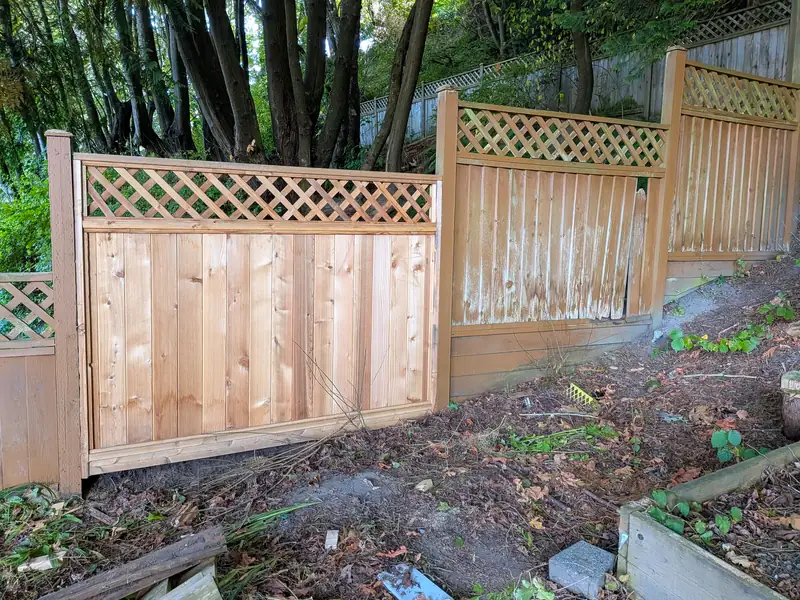
A real Ironwood Grounds repair, same angle before and after: a leaning lattice-top panel on a sloped yard replaced with a new cedar panel on the same line.
On a retaining wall? Delta measures from the top side.
This is where Delta differs from Surrey. When a fence sits on a retaining wall, Delta measures the fence height from the finished grade on the higher side of the wall, and any part of the wall that sticks up above the soil it holds back counts as fence (s. 7.6.2). The exception is the front or exterior side lot line where your lot sits above the street: there, height is measured from the average of the finished grade on each side of the wall, so part of the wall counts.
The wall has its own limits too. On residential land, a retaining wall can be at most 1.2 m, measured from the finished grade of the lower ground, and stacked walls need at least 1.2 m of horizontal separation between them, unless the wall is holding back a neighbouring lot or street that sits higher than yours (s. 7.6.1). Along a street frontage, block walls are limited to blocks no larger than 30 cm high by 60 cm wide (s. 7.6.3).
Do you need a permit?
Generally not. The City of Delta says standard fences that meet the Zoning Bylaw can be built without permits or approvals, but it flags special consideration in development permit areas, heritage conservation areas, steep slopes and tree protection zones. A fence that goes over the limits is not a simple fence permit: under s. 7.5.6 it has to meet the maximum height and minimum setbacks for a house in that zone. If your plan pushes a limit, confirm with Delta's Development department before you build.
Delta will share the cost with some owners.
If your fence borders City-owned land, Delta runs a fence cost-sharing program. The City's published maximum is $23 per lineal metre or 50% of the fencing cost, whichever is less. The details and application form are on Delta's residential building page, linked in the sources below.
For a fence between two private neighbours, height rules do not decide who pays. Our guide to who pays for a fence between neighbours in BC covers that.
Surrey and White Rock set their own rules.
Delta's numbers do not carry across the border. White Rock allows a taller fence almost anywhere on the lot but has a strict corner rule, and Surrey's front-yard and retaining-wall rules work differently. See White Rock fence rules and Surrey fence height rules if your property is across the line.
The details homeowners ask about.
How high can a backyard fence be in Delta?
Up to 1.8 metres (about 6 feet) anywhere behind the minimum front setback for your zone. Along a lot line that borders a non-residential zone, that stretch of fence can go to 2.4 metres, still behind the front setback.
How high can a front yard fence be in Delta?
1.2 metres (about 4 feet) in front of the minimum front setback in most residential zones. On a lot zoned RD2, the front setback limit is 0.9 metres. Corner visibility rules can lower it further.
What are the corner lot rules in Delta?
At a street intersection, measure 8 metres along each lot line from the corner and join the two points. Inside that triangle, no fence or other structure except a permitted house can be over 1 metre, and plants must not block the view between 1 and 2.4 metres above the curb. The rule does not apply at lanes.
Does a retaining wall count toward fence height in Delta?
Usually not in full. Delta measures a fence on a retaining wall from the finished grade on the higher side of the wall, and any part of the wall that sticks up above the soil it holds back counts as fence. The exception is a front or exterior side lot line where your lot sits above the street: there, height is measured from the average of the finished grade on both sides of the wall.
How is fence height measured in Delta?
From the finished grade at the base of the fence, checked every 2 metres along its length. On a sloped yard, each section has to stay within the limit where it stands, which is why fences on a slope are usually stepped.
Do I need a permit to build a fence in Delta?
Generally no. The City of Delta says standard fences that meet the Zoning Bylaw can be built without permits or approvals, with special consideration in development permit areas, heritage conservation areas, steep slopes and tree protection zones. A fence over the limits has to meet the height and setback rules for a house in that zone.
Do the same rules apply in Ladner, Tsawwassen and North Delta?
Yes. Ladner, Tsawwassen and North Delta are all part of the City of Delta and use Delta Zoning Bylaw No. 7600. Check your zone first, because RD2 and comprehensive development (CD) zones can differ. Tsawwassen First Nation lands are not covered by Delta's bylaw.
Sources, and an honest disclaimer.
This page is general information, not legal advice. Bylaws change, and your property may have site-specific rules. Every number above was checked on September 29, 2026 against these City of Delta sources:
- Delta Zoning Bylaw No. 7600, 2017 (consolidation dated April 21, 2026): s. 7.2.1 (visibility at intersections), s. 7.5 (fences), s. 7.6 (retaining walls), and the Part 2 definitions of fence, arbor and front lot line.
- City of Delta — Residential building & renovating: fence permits, measuring, and the fence cost-sharing program.
- City of Delta — Your Property: how to look up your zone and setbacks on DeltaMap.
Before building, confirm the current requirements for your lot with the City of Delta's Development department, your strata if you have one, and a surveyor if the property line itself is in question.
Verified September 29, 2026.
Planning a fence near a limit? Ask first.
Tell us your neighbourhood and what you are planning. We flag setback, corner-triangle and retaining-wall issues during the quote, before they become a problem with the City.